
Choosing the Right DTF Adhesive Powder: Fine, Medium, or Coarse?
A perfectly printed DTF design can fail because of just one thing: the adhesive powder. It’s the most unassuming component in the entire process—and yet it’s the one that’s most often used in the wrong amount or with the wrong grain size. If it’s too fine, fine lines will crack during washing. If it’s too coarse, a delicate T-shirt design will feel like a silicone pad.
Anyone who regularly produces DTF transfers can’t avoid this decision: Which grain size is right for which design, which fabric, and which press setting? This article clarifies the three common categories—fine, medium, and coarse—and explains what really matters when it comes to selection and application.
What the adhesive powder Actually Does in the DTF Process
After printing onto the transfer film, the ink is still wet. At this point, the hot-melt powder - usually a PU adhesive in powder form - is evenly sprinkled over the surface and adheres to the printed areas. The film then undergoes a melting process during which the powder bonds to form a continuous adhesive layer. It is this layer that ensures, during the subsequent pressing, that the design bonds permanently to the fabric.
The particle size of this powder is specified in micrometers (µm) or mesh and directly influences three factors: the sharpness of the design’s details, the feel of the finished fabric, and how well the adhesive fills the spaces between the fabric fibers.
Ultra-Fine Powder: When Less Is Not Enough
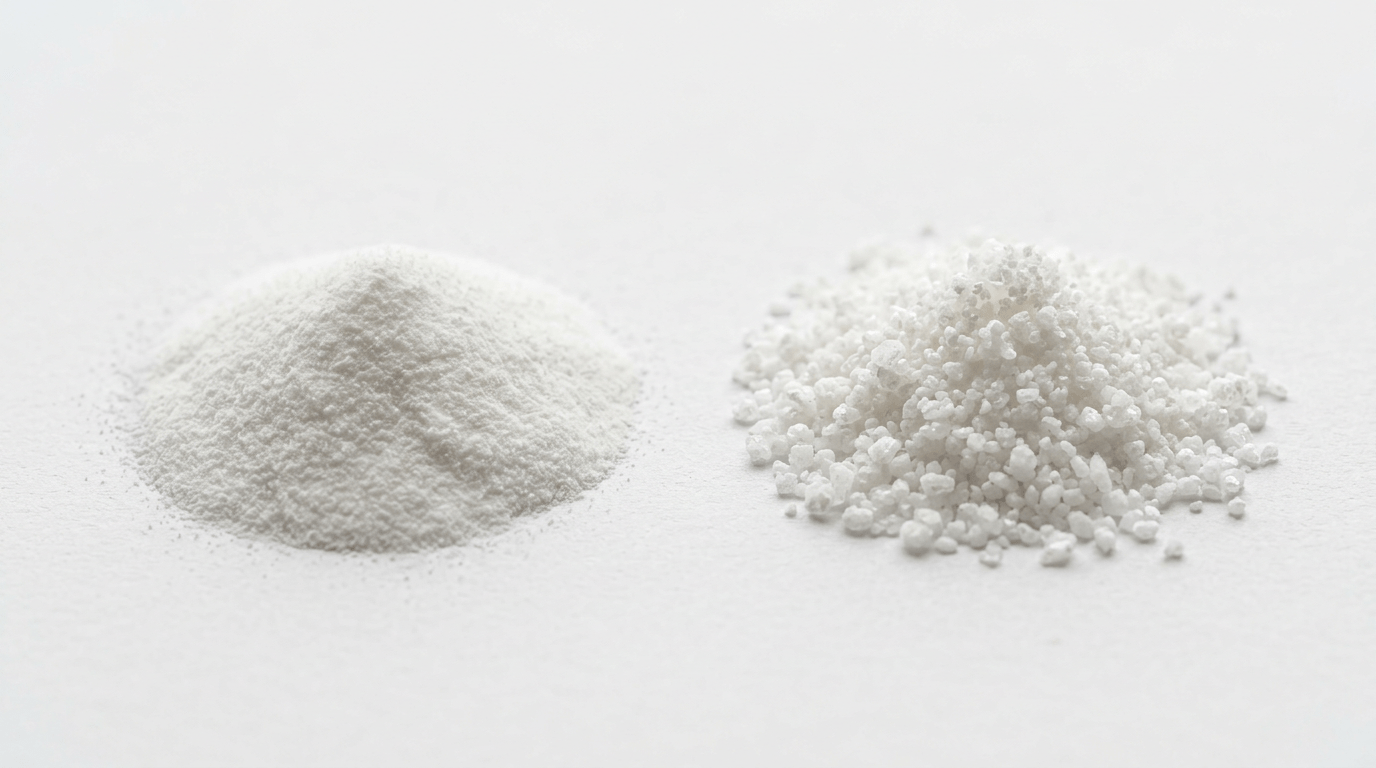
Super Fine Powder, with a particle size of 0 to 80 µm, is the finest powder available for this application. It is designed for printing where the adhesive powder is barely noticeable. The goal is to create a texture that comes close to that of direct printing. In addition, small amounts of adhesive can be processed more quickly.
Unfortunately, with this fine powder, the amount of adhesive is so small that durability suffers. Although the texture is very soft, cracks or peeling image elements can be expected after just a few washes. It can also only be pressed onto fine fabrics with little texture.
Fine Powder: Precision for Details and a Soft Feel
Fine powder typically ranges from about 80 to 120 µm. It is particularly well-suited for intricate designs, small text, and designs with many fine lines because it conforms precisely to the print outline and does not form visible clumps when melted. It leaves a soft, barely noticeable texture on the fabric—ideal for lightweight cotton shirts, women’s clothing, or children’s designs where a stiff, thick print would be distracting.
The downside: Fine powder provides less adhesive volume per unit area. For large-scale designs or high-wear applications, adhesion may diminish after some wash cycles if the powder is applied too sparingly.
Medium Powder: The Allrounder for Everyday Use
With a particle size of approximately 80 to 170 µm - defined differently depending on the manufacturer - medium powder is the most common choice for standard T-shirts made of cotton or cotton blends. It combines good adhesion with a soft feel and is more forgiving of minor variations in application amount and press temperature than the finer variety.
For businesses that handle a wide variety of orders — from club logos to promotional apparel — medium powder is often the most practical basic option, before stocking additional fine or coarse powder for special cases.
Coarse powder: Maximum adhesion for challenging fabrics
Coarse powder ranges from approximately 120 to 250 µm. It applies significantly more adhesive to the surface and is therefore suitable for textured or heavy fabrics such as canvas, denim, fleece, or technical performance textiles, where the surface is more irregular and requires more adhesive to bond reliably. Coarse powder is also often the safer choice for workwear and sportswear, which are frequently washed and subjected to heavy wear.
The trade-off is in the feel: The finished print feels firmer and thicker. For very fine lines or very small text, the contours may also lose some sharpness because the larger particles do not fit as precisely into tight spaces.
Adjust the dosage and pressing temperature correctly
Particle size alone does not determine print quality — only when combined with powder application and press settings can you tell whether the transfer will hold. If too little powder is applied, gaps remain in the adhesive layer, which later become noticeable as rough spots or edges that peel off prematurely. Too much powder, on the other hand, results in a thicker, stiffer layer and unnecessarily increases material consumption.
The melting and pressing temperatures must also be suited to the selected particle size: Finer powder generally melts slightly faster and more evenly, while coarser powder often requires a slightly longer melting time or a slightly higher temperature to melt completely. Incompletely melted powder is one of the most common reasons for transfers that peel off after just a few washes. It is therefore worth conducting a short test print followed by a wash test after every change in powder type before switching over to regular production.
Practical Tips for Making the Right Choice
If you don’t want to match your powder to the fabric, the mid-range options are a good choice. A DTF adhesive powder with a particle size of 120–170 µm can be applied to almost any fabric. A very comfortable feel combined with durability of about 50 washes at 40°C makes this allrounder the go-to solution.
For those who want to be more precise, here are a few basic rules to follow in practice: First examine the design and fabric, then choose the particle size — not the other way around. For mixed application profiles, it’s worth keeping medium-grain powder as your standard and reserving fine or coarse powder specifically for special cases. Storage is also important: adhesive powder absorbs moisture from the air, which leads to clumping and uneven melting behavior. Airtight containers and a dry, temperature-stable storage location are therefore essential.
Compatibility with other consumables is also important: powder, DTF transfer film, and ink should be matched as closely as possible to ensure that color reproduction, wash resistance, and print quality are reliably consistent.
If you’re unsure which particle size is best suited for your DTF printer and production volume, it’s best to test small quantities on the actual target fabric before producing larger batches.
Choosing the right adhesive powder is a matter of experience and that’s exactly where DIGITRAN supports its customers with personalized advice instead of off-the-shelf solutions. From the right DTF adhesive powder in fine, medium, and coarse grain sizes to a complete set of consumables:
Contact Us
We help you find the right solution for every design and every fabric.
Click the button to contact us directly and receive personalized advice. That way, your products can benefit from this unique, clean, and digital printing technology as quickly as possible.
Further Posts
How can sports jerseys and functional shirts be customized without compromising performance?
Customized logos, names or numbers are standard today – but there are many challenges, especially with polyester and elastic fabrics: Sensitivity to heat, color gradients and lack of stretch. In our blog, we show how modern heat transfers overcome these hurdles and what is important to ensure that design and function work together perfectly.
What is DTF? We explain it!
Welcome to the fascinating world of DTF printing, where flexibility and quality come together. Dive into our detailed insight into the process – from the innovative DTF printers to the automatic powder shakers to the transfer press. Discover how this technology is redefining the boundaries of printing.
Thinking about buying a DTF printer? The world of Direct to Film (DTF) printing offers a versatile and profitable method for transferring high-quality, full-color designs onto various textiles such as apparel, bags and more. In this comprehensive guide, we will ask important questions and provide valuable insights to help you make an informed decision about purchasing a DTF printer.
The solution for custom designs on t-shirts, hoodies, bags, sportswear and workwear: DTF Digital Transfers.
Thanks to the combination of digital printing and heat transfer technology, textile transfers can be printed in small quantities, full-color and in the shortest possible time. Thus, the outstanding opacity and feel known from plastisol and screen printed transfers is now also available in small quantities.
Besides many other factors that can influence the heat transfer process, the three most important ones are heat, time, and pressure. No matter if it is a textile transfer or a transfer for packaging applications, you should know about the effect of these parameters and how a transfer is affected by them.